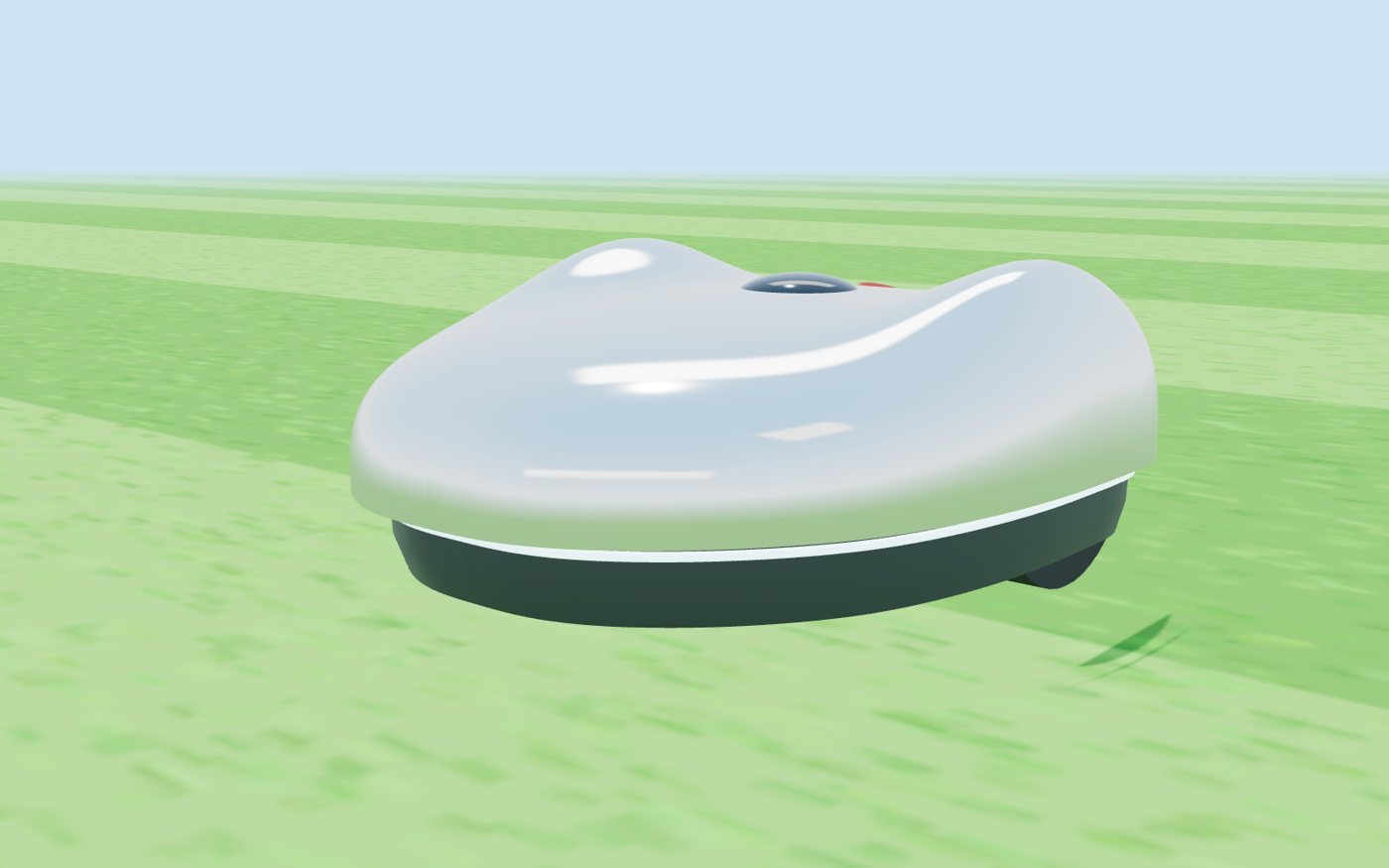
No cloud. No subscription. No app that stops working when a company changes its mind. Mowlark mows your lawn, goes home to charge, and stops for a hedgehog. Every part of it is written down so you can fix it, change it, or build your own.
paid for by the founder. We're not asking for money yet.
1 of 5
goals reached
39 posts
in the devlog, mistakes included
The idea
Robot mowers are closed boxes. This one isn't.
Today you buy a robot mower and rent the rest: the app, the cloud, the updates. When any of those go away, the mower gets worse or stops. We think a machine that lives in your garden for years should belong to you.
Yours to keep
No account, no cloud, no subscription. It runs on its own computer and keeps its records on your network.
Yours to fix
Standard parts with a shopping list and prices. Software we'll publish under an open licence. A build manual for every step.
Careful by design
It doesn't mow at night, when hedgehogs are out. It stops for a ball, a hose or a child's foot. A big red button stops it, no app needed.
Proven before it's built
Every behaviour is tested on a virtual twin of the robot and the yard first, with a pass or fail report. Mistakes there cost nothing.
GPSFIXEDblade300 rad/scut0%time0.0 s
It already mows, in simulation
95% of the lawn cut, in neat stripes, round flowerbeds and trees
Back on its charger to within about 1 cm, then it carries on where it stopped
Sees a hedgehog-sized animal 1.2 m ahead and stops with room to spare
Refuses to mow grass that's grown too long to see an animal in, and tells you why
These numbers come from automated tests on the simulated robot. Real lawns are harder, which is what the goals below are for.
The goals
Five steps from a computer screen to your lawn
Each step has to pass its tests before the next one starts. The blade is the last thing to switch on, not the first.
1
Prove it in simulation
A virtual robot in a virtual yard: mowing, charging, avoiding obstacles, handling faults. Over 100 automated tests.
$0Done
2
Sensors on a garden cart
The robot's brain and centimetre-accurate GPS, pushed around a real lawn by hand. It maps the edges. No motors, no blade.
≈ $500–700Next
3
A real robot, blade off
A second-hand robot mower gets a new brain: an open-source controller board and our software. It drives the lawn and docks itself.
≈ $600–700Planned
4
Eyes for safety
A 3D laser scanner, the same kind tested in simulation, so it can see a ball, a hose or an animal and stop.
≈ $1,000Planned
5
Blade on, supervised
Only after every item on the safety checklist passes: stop button, lift and tilt sensors, a hardware watchdog. Someone watches the first runs.
≈ $100Gated
+
Stretch: its own body
The chrome shell in the pictures, with our own frame, motors and battery. Only if the second-hand body holds us back.
≈ $1,500+Optional
Funds needed · prices checked 8–10 Nov 2026
Where the money would go
These are real prices with sources. Nothing is padded, and the founder is paying for all of it for now. Everything is in US dollars, rounded; parts priced in euros are converted at an approximate $1.12 per € (Nov 2026).
What
For
Cost
Raspberry Pi 5, centimetre GPS (RTK), motion sensor, storage
Goal 2: the robot's brain and senses
≈ $500–700
A used YardForce Classic 500 robot mower
Goal 3: a body, wheels, blade guard, battery and dock that already work (used listings)
≈ $340
OpenMower controller board kit
Goal 3: the open-source board that drives the motors (shop)
Safety electronics: stop button, sensors, a small safety computer
Goal 5: the blade interlock (estimate)
≈ $100
Goals 2–5: a real robot mowing a real lawn
≈ $2,200–2,500
And to make one you could buy?
That's a different scale: safety certification for robot mowers, moulds for the body, product insurance and more people. We haven't put a number on it, because it would be a guess. We'll only look at it if enough people want one.
How to help
Not taking money. Taking interest.
We'd rather show a working robot than ask for trust. What helps most right now costs nothing.
Follow along
Every step is in the devlog, written as it happens, including what went wrong.
Share it
Know someone with a lawn and a soldering iron, or a robotics student? Send them this page.
Later, maybe
Ideas for when there's a real robot: a course on building one, and a blade-free kit for builders. Ideas only: nothing is for sale and there are no prices.
Risks and challenges
What could go wrong, honestly
Blades are dangerous
So the blade stays unplugged until the safety checklist passes, and the first runs are supervised. This is a hobby project, not a certified product.
Real lawns are harder than simulated ones
Wet grass, slopes, and GPS that drifts near houses and trees. Goal 2 tests the GPS on a real lawn before any motor turns.
It's a side project
Progress comes in small steps, each one written down, so nothing is lost if things go slowly.
Parts prices move
Raspberry Pi prices rose more than 70% in 2025–26. The software isn't tied to one computer, so we can switch if we have to.
Questions
FAQ
Can I buy one?
No. Nothing is for sale. Today Mowlark is a simulation, a set of plans and a devlog. The goals above are how it becomes a real robot.
Do you want money?
Not yet. The founder is paying for goals 2 to 5. If we ever ask, it will be after there's a real robot to show, and we'll say exactly what the money is for, like the table above.
Will it work on my lawn?
It's being designed for lawns with a clear view of the sky, because it finds its way with centimetre-accurate GPS. Narrow side passages under trees are the hardest case, and we'll test them on a real lawn in goal 2.
Are you building your own electronics?
Eventually. The first real robot uses a ready-made board from OpenMower, an open-source project for converting robot mowers, because a board that's known to work is the fastest way to learn the mower's wiring. After that we plan to design our own board. It will have the hardware blade interlock built in and use parts anyone can buy. OpenMower publishes its YardForce board design under a licence that allows reuse, which saves most of the detective work.
Does it need an app or the internet?
No. It runs on its own computer. Two buttons on the robot start, pause, send it home and stop it. A phone app is planned for editing the map, and it will talk to the robot directly.
What about pets and wildlife?
It doesn't mow between dusk and dawn, when hedgehogs are about. It stops for things it sees in its path. And it won't mow grass that's grown too long to spot a small animal in: it goes home and tells you instead.
Will there be other models?
Maybe. Ion, the one we're building first, is one of six first-pass designs: a small one for side passages, a four-wheel-drive one for rough ground, one on tracks for slopes, a wide twin-blade one for big lawns, and one with a sensor mast and a solar roof. Each is a profile the same software reads, and each passes a quick test in the simulator. Only Ion is being built. See the platforms.
Who's building it?
Chris F, a Python developer learning robotics, working with Claude as an AI pair-engineer. The devlog shows how.
For the curious
Under the hood
The simulation, the bugs it caught, the parts list, the wiring, the safety interlock and the 3D design, all in detail. And the six robot platforms one software stack runs, from the small Quark to the twin-blade Tachyon.
The mower kept getting stuck in the same corner of a model of a real yard. It turned out to be two bugs stacked on top of each other. The safety gate was right but late, and the plan asked the robot for a move it could…
For a few days the backlog has carried one line: on the bumpy test lawn, with 7 cm grass, the robot sometimes stops for nothing. We'd guessed it was grass on a bump reading too tall. It wasn't. The robot was stopping…
An evening of ways the robot got stuck, and how each one now gets caught: a dock that faces a wall, a lidar that looked at ground it can't see, and a mower that stopped at an angle to its line and waited forever. Plus a…
The last post ended with the robot's camera never calling either dog a dog, and a guess why: they came in from the side, and the camera looks forward. So we gave the camera a fair test, with a dog that crosses in front.…
The simulated dog that runs at the robot has a name now. Two, actually: Clover and Moose, the two dogs who will share the real lawn with this robot. Clover got a sim model last week. Moose asked (through Chris) not to…
The last post ended with one false alarm left: a fence that "moved" because the robot thought it was facing 7° away from where it really was. 7° doesn't sound like much. At 5 m it moves a fence 60 cm, and that's enough…
 mowlark