The website gets a front door (and a budget)
Chris's feedback on the public site: the styling and tone are right, but it's very tech-forward. The first thing a visitor met was a canvas of stripes labelled "RTK FIXED" and "300 rad/s". Good if you already care, but no help if you don't. So the site now has two layers: a plain-language front page that says what the robot is for, what the goals are and what they cost, and all the detail one click behind it on How it works.
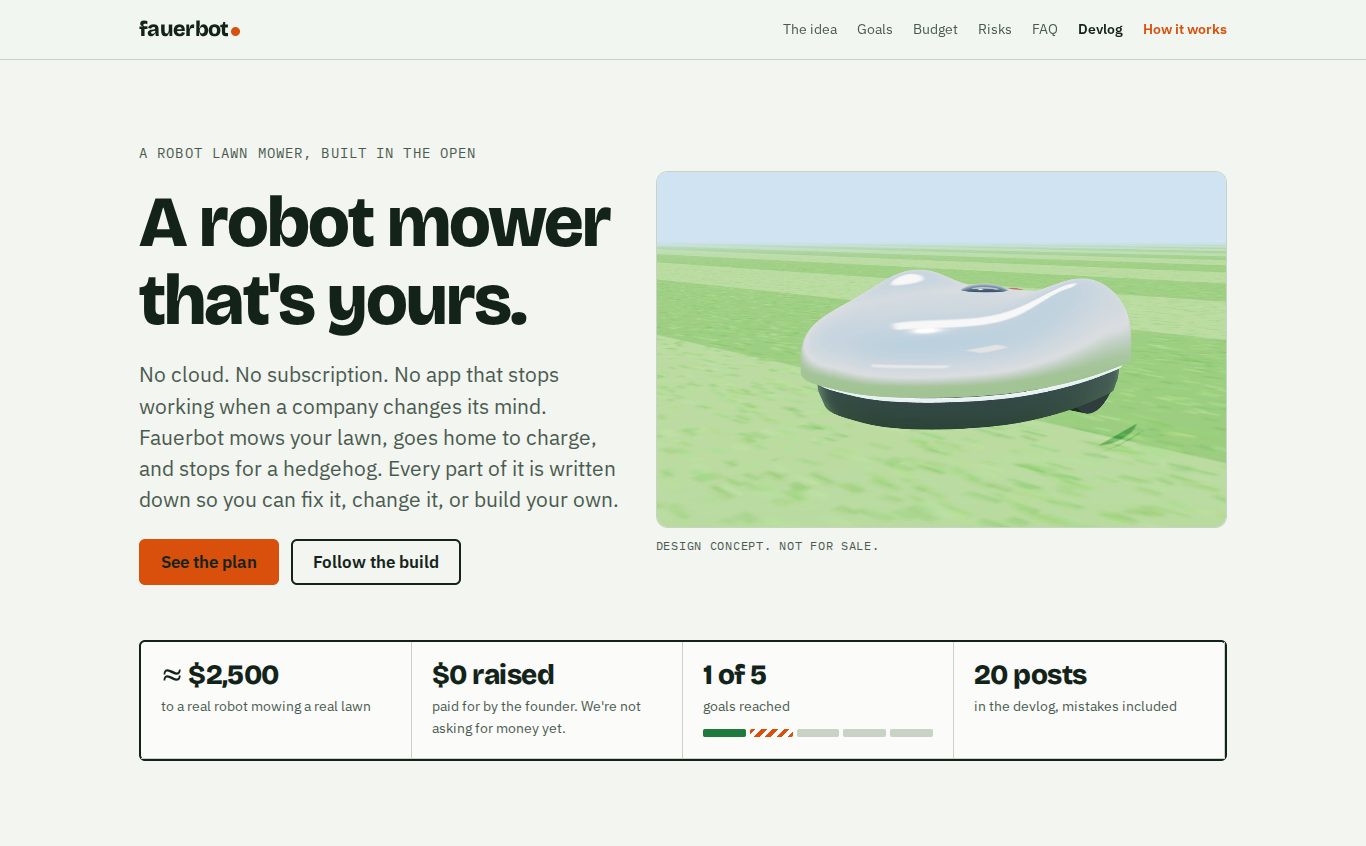
A crowdfunding page with nothing to sell
The shape we borrowed is a crowdfunding campaign page: a promise at the top, a status panel, goals, where the money goes, risks, an FAQ. It's a good shape because it answers the questions people actually have, in the order they have them. But we're not raising money, so every part had to be honest about that:
- The status panel shows the budget to a real robot (≈ $2,500), then $0 raised, and says why: the founder is paying, and we're not asking. A "1 of 5 goals" meter replaces the usual funding bar.
- The goals are the hardware stages H1 to H4 from the plan, renamed for people who don't read plans: sensors on a garden cart, a real robot with the blade off, eyes for safety, blade on and supervised. Each has a cost and a status. The custom chrome body is a stretch goal, because that's what it is.
- The budget has a source for every price: our parts list (checked 8 Nov), used YardForce Classic 500 listings at about €300 (≈ $340), the OpenMower board kit at €225–300 (≈ $250–340), and the Livox Mid-360 3D lidar at its $979 list price. The lidar is the biggest single item. The safety electronics (about $100) are the only estimate, and the table says so.
- "And to make one you could buy?" gets an honest non-answer. Certification, moulds and insurance are a different scale of money, and any number we put there today would be a guess.
- Risks and challenges opens with the blade, because that is the real risk.
The "how to help" section asks for attention, not money: follow along, share it. The ideas for later (a course and a blade-free kit for builders) are listed as ideas, with no prices, so nobody reads them as a pre-order.
Moving the detail, not deleting it
Nothing technical was removed. The old landing page moved to how-it-works.html almost word for word: the findings,
the mowing numbers, the stage list, the diagrams, the parts list and the safety interlock. The only changes there are
a link back and an updated licence note (Apache-2.0 and CERN-OHL-S are decided now). The front page keeps the
animated lawn, with plainer labels, and ends with the latest devlog posts.
Two small bugs turned up in the screenshots. The "All 20 posts" button had rendered as "All20posts" for weeks: a
flex container drops the spaces between a text run and a <span>. On a phone, the budget table scrolled its cost
column off the screen, and the cost is the whole point of that table. It now stacks on narrow screens.
scripts/website_screenshot.py now shoots both pages at both sizes and reports any horizontal overflow (none).
Real hosting
The site is also on real hosting now, on GitHub Pages from a separate public repository that holds only the
generated files. make publish-site builds the site and pushes it there. The source stays private for now.